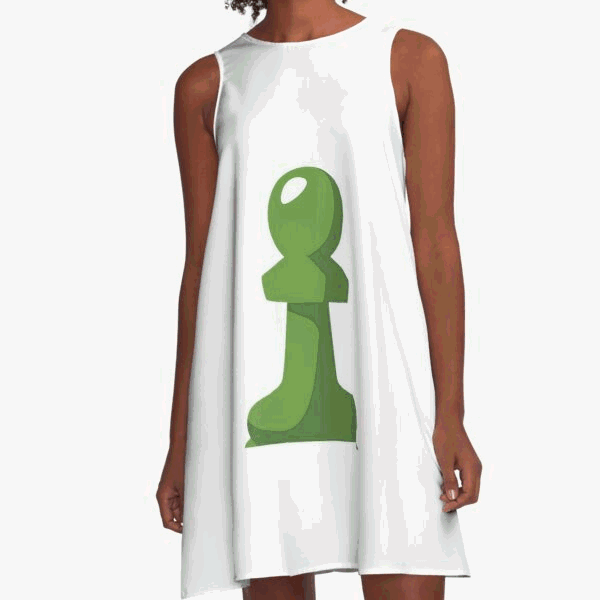
The Chess Dress and a Date with an Old Mate.
By 10 Apr 22 on


8044 views
I have ordered one, watch this space for soon to seen pictures of me wearing it
(with my chess hat!) and parading along a catwalk at a fashion show in Paris.
I was going through an old scrap book of chess cuttings from ‘The Scotsman’
dated from the mid to late 1800’s. I came across this printed a few weeks apart.
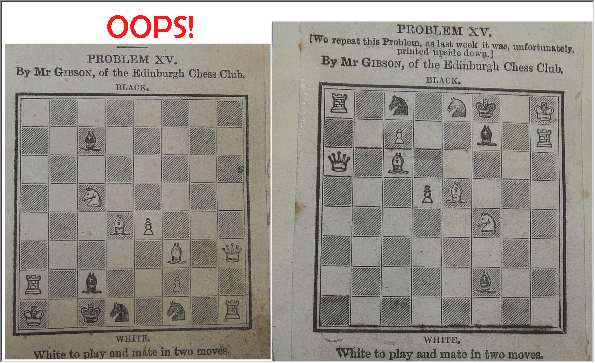

This is how the problem should have been seen.
White to play and mate in two. (give it go, it’s a goodie) solution at the bottom.
Clue:
The first move is not a check. They rarely are in these puzzles.
The original setting must have driven the Victorian solvers mad.
This was before radio and even crosswords and these problems were very popular.
This is how the problem first appeared.
There are a handful of mates in three moves but no checkmate in two moves.
Finding those mates in three would have made the solvers think they are close.
Can you imagine after two frantic weeks of trying to solve it you are then informed that
the diagram was printed upside down. (these days one would seek financial compensation.)
We start with this by an unknown composer from ‘The Scotsman’ 1893. (this one is sound.)
White to play and mate in two moves. it was given as ‘...an aid to our novice players.’
Solution:
1. Kg2 and any Black move allows a Knight checkmate.
Moving on, now skip through this game.
Bobla45 - beatlemania RHP 2019
You get the idea of this weeks theme. Setting up Knight Forks. One more RHP example.
abeehilmorst - spats RHP 2018
This is from one of the most common setting (pattern) for this idea to work.
This is the bones of the pattern. 1.Qxa8 Qxa8 2.Nc7+ and Nxa8
Here is an example from a master game. Black sets a trap based on the fact the good
player (Tarrasch) will spot the Knight fork and fall in with their carefully laid plan.
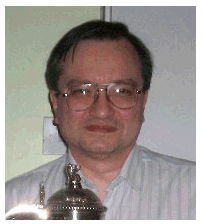
Siegbert Tarrasch
(er....that is not Tarrasch.....Russ)
I know but Ed Sheeran might have the copyright on all of the Tarrasch pictures.
S. Tarrasch - J. Berger, Breslau 1889
Black has just played the trap 32...Rb8-c8
Can you see a shot here that ends with the Knight checking on the square e7.
Try and get into the habit of Checking all Checks in every position, this sparks ideas.
But also get into the habit of wondering why your opponent has left you a good move.
One more RHP example, this is good.
Recircc - Arayn RHP 2021


An old feature where we look at a game from a previous blog (this one was 8 yeas ago)
These wee gems of creativity should be played over every now and then to cheer you up.
Here we recall that infamous game where White takes 9 (yes nine) pieces on the trot.
(six pawns, a Rook, a Bishop and a Knight) and after taking the 9th piece resigns.
CountBatou - Sydrian RHP 2011
This game starts with 1.g4. The Grob', named after a Swiss lad called Henry Grob.
Some opening books call it 'The Spike' which was the name of Henry Grob’s dog.
The mate in two by Gibson solution.
1.Qf1. Every Black move now allows checkmate next move.
The thread accompanying this blog is Thread 192880