The Flanders Panel (Chess)
By on 23 Jun 26 06:52


25 views
The title; “The Flanders Panel (Chess)” is thus because I have been told
by my computer expert. Tommy the next door neighbours 11 year old,
that web crawlers come out at night and pick up on the word ‘Chess’ so
I must try to include the word ‘Chess’ in every title. Sometimes I forget.
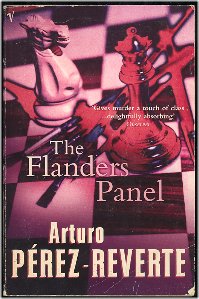
Found in a ‘Four for £1.00’ oddment bin.
The Plot.
A 15th century painting of two noblemen playing chess is undergoing restoration.
However it has come to light that two years before the picture was painted one of
the noblemen was murdered. The words, in Latin, “"Quis Necavit Equitem" have
shown up in an x-ray. That translates into English as: "Who killed the Knight?"
This is the chess position that appears in the painting.
Yes. I am afraid it is one of them. ‘Them’ being a dreaded retrograde position.
White has captured four pawns, a Rook and Bishop.
Black has captured two pawns a Bishop and a Knight.
One has to figure out who, or what, took ‘murdered’ the White Knight.
(I’m guessing it was a Black Knight with a lead pipe in the conservatory.)
To solve the murder you have to figure out what was Black’s last move.
It could not have been a pawn or Bishop or the b8 Knight that moved last.
The d1 Knight did not just move because it must have come from a square
giving check to the White King. The Black King could have moved from
a3 - a4 to get out of a check from the b1 Knight but how did the Knight get
to b1? Impossible. So the last move must have been made by the Black Queen.
It was not from a2, b3 or d3 because the White King would have been in check.
Therefore the last Black move was Qb2-c2 and in doing so, took the White Knight.
(There will be, or there should be retrograde proof why there was a Knight on c2.)
So without reading the book I reckon it was a lady who bumped off one of the noblemen.
A great man, everyone forgets who, once said; “...three pieces always mate.”
Black to play. You have to find a Rook mate, a Knight mate and a Bishop mate.
Black to play, look for checkmates in two moves.
I cannot believe how kind I am to you guys. The Rook Knight and Bishop all
figure in the next one. (I’m thinking this is too many clues..) White to play.
Two Bishops and a Rook play their part in this one. (White to play)
S. Gligoric - Rosenstein, USA, 1963

Unknown, Unseen and Unsung
An old feature you have never heard of (basically because I have just made it up.)
Sometimes, often whilst looking for something else, I stumble across interesting
moments from obscure OTB games. I seem to have this gift for attracting games
with blunders or missed instructive moves . I do not seek them out. They find me.
J. K. Christenson - J. A. Pietzcker, Sydney, Australia 1901
These two relatively unknown players produced a couple of interesting positions.
Here, White played the natural looking and 25. Rd1 but there was a better move.
Because this bit is called; “Unknown, Unseen and Unsung” I’ll hide the answer.
White did go onto win but only because Black made a plausible error.
To see what else happened in this game we use two RHP examples.
nating44 - mothercat RHP 2010 (Black to play)
Black cleared a patch for the d-pawn 56.Rxf2+ Kxf2 d2
The pawn promotion cannot be stopped and Black won.
flexmore - dyl RHP 2004 (Black to play)
Chess history has more than a few lessons where a pawn on the 6th
or 7th rank has caused a player to miscalculate or miss a simple tactic..
Black possibly saw that 44....c2 is met with 45 Qe5+ winning for White so
played 44....Kxf4 (44....Ra5 is best) 45. Qc1+ followed by Qxa3 was 0-1
Back to J. K. Christenson - J. A. Pietzcker, Sydney, Australia 1901
Black to move played the ‘winning’ move 33...Rxd2 which does indeed win
should White comply and play 34.Qxd2 b2. However we are very vulnerable
when playing our ‘winning’ moves. We have the win in our mind and switch off.
White did take the Rook but not the Rook Black wanted them to take.
33...Rxd2 34.Qc8+ followed by Qxb7 White resigned a few moves later.
The thread accompanying this blog is Thread 205686